
Work in Progress – Did You Check It? Checklist for Redesigning a Laboratory Experiment in Engineering Education Addressing Competencies of Learning and Working 4.0
Due to the possibilities of digitalization, the world of work is undergoing a profound change towards Industry 4.0 and related Learning and Working 4.0. In this context, new competences are expected from employees, which must also be addressed in STEM disciplines, especially in higher engineering education. Lab courses are particularly suitable for this, because here students can actively work on devices and potentially cyber-physical systems. This contribution is the undertaking of a group of lab teachers from various disciplines working on the joint project CrossLab to formulate what they consider the important aspects of lab teaching as learning outcomes for Industry 4.0. Furthermore, as a final goal, they will be transferred into a checklist that can be used in the implementation of existing and newly designed lab experiments with regard to the required competences of Learning and Working 4.0. Constructive Alignment forms the pedagogical framework, in which intended learning outcomes, teaching–learning activities and learning outcome monitoring must be thought through and planned as a whole. The checklist will extend an existing checklist for the thirteen conventional fundamental lab learning-objectives according to Feisel and Rosa. This work in progress describes first results of this attempt.
Auf einen Blick
Autor:innen & Herausgeber:innen
Das könnte Sie auch interessieren

Living AI-ducation Dashboard
The rise of artificial intelligence (AI) is transforming education and calls for more research and trained experts. Our teaching project aims to develop and evaluate the course "Intelligent Learning: AI in Education" and to integrate it into our existing Educational Technology Master's program. Students, together with instructors, in the course will create a comprehensive learning and information resource called the Living AI-ducation Dashboard, which will keep students up-to-date on research and development in the field of AI in education. Interdisciplinary team teaching and project-based learning will be implemented to help students develop interdisciplinary thinking. The project will involve students of subsequent cohorts in developing, maintaining, and further improving the dashboard. In Phase 1 of the project, the project staff will and prepare basic content (e.g., educational AI applications, data visualization, methods of research syntheses, science communication) and work assignments for the course. During Phase 2, students of the first cohort will design a blueprint for the dashboard, which will be implemented with the support of the project staff. In Phase 3, the next cohort will gather data according to the blueprint and visualize it for publishing on the university website as the "Living AI-ducation Dashboard." Afterwards, the dashboard will be evaluated. In Phase 4, the next cohort will and improve the dashboard, and implement new features.
Projekt anzeigen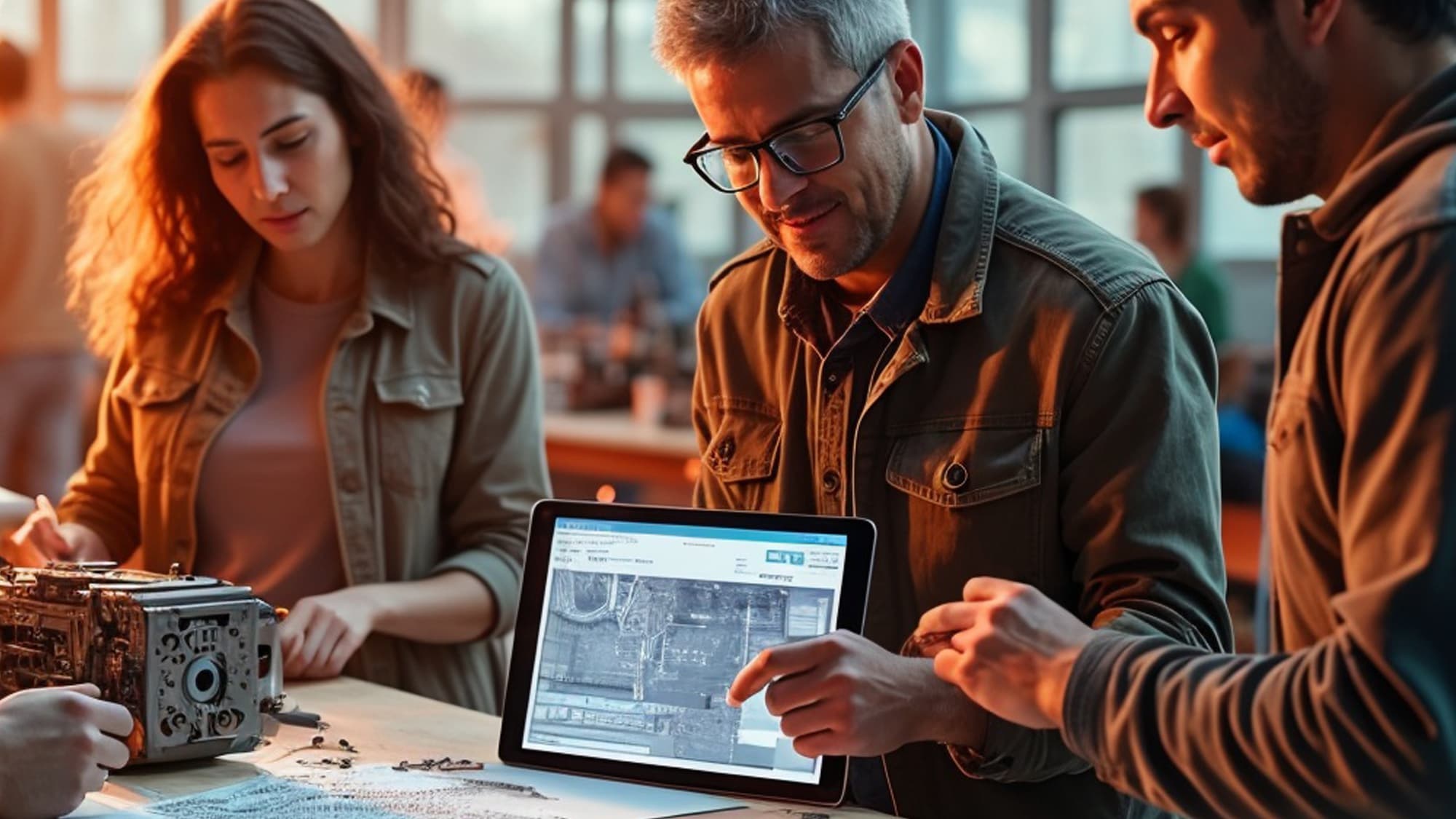
Digitale Barrierefreiheit
Barrieren im Zugang zu Lerninhalten können auf verschiedenen Ebenen entstehen, etwa im Browser, dem Lern-Management-System (LMS) und dessen Objekten oder dem Lerninhalt. Bei der Erstellung und Pflege unserer digitalen Selbstlernumgebung ist unser Ziel, sowohl durch die Wahl des (idealerweise für User kosten-losen und datenschutzgerechten) LMS als auch der konkreten Ausgestaltung ein optimales Nutzungserlebnis unabhängig von ggf. vorhandenen persönlichen Einschränkungen zu erreichen. Dazu gehören insb. die Zugäng-lichkeit, Verständlichkeit sowie Navigierbarkeit. Das hier genutzte LMS ILIAS zeichnet sich dabei durch eine stetige Verbesserung der Zugänglichkeit. Unsere Umsetzung umfasst die weitestmögliche Verwendung der so zur Verfügung gestellten Tools sowie einer klaren Seiten- und Navigationsstruktur, einem einheitlichen Design und Farbkonzept mit Berücksichtigung kontrastreicher und barrierearmer Farben und einer einfachen und gendersensiblen Sprache.
Maßnahme anzeigen
Schmitz, Sigrid (2026): Es ist doch schon alles da! Gender in MINT & More.
Was hat Gender mit Biologie, Chemie, Mathematik, Informatik oder Physik zu tun? Antworten darauf gaben wir am 18. Dezember 2025 beim Wissenschaftstag #4Gender Studies mit unseren Lehrunterstützungen aus Gendering MINT didaktisch-digital bei einem Lunch Talk im „Netzwerk Gute Lehre“ in Kooperation mit dem bologna.lab der HU Berlin. In: GenderBlog, Zentrm für transdisziplinäre GeschlechterStudien, HU Berlin, 12.02.2026
Publikation anzeigen